
Most Tampa Bay roof leaks don’t start in the “field” of the shingles. They start where the roof gets complicated: walls, chimneys, valleys, skylights, pipe penetrations, and edges. That’s why Steadfast Roofing in Riverview, FL treats flashing as a roof-system decision, not a line item to “maybe” swap later.
What Roof Flashing Is and Why It Matters in Florida Weather
Roof flashing is shaped metal (or specialty waterproofing materials) installed at transitions and penetrations to direct water back onto the roof covering and into the drainage path. Without it, water will follow gravity, capillary action, and wind pressure into seams that shingles alone can’t seal.
Tampa Bay makes flashing work harder than most places:
- Wind-driven rain can force water to lap, move sideways, and rise, especially during tropical storms and squall lines.
- Heat and UV radiation accelerate sealant breakdown and cause joint movement.
- Salt air (coastal areas) accelerates corrosion and causes pinholes in lower-grade metals.
- Sudden downpours quickly load valleys and wall lines, exposing tiny defects.
Flashing is not an “optional “extra protection. It’s how a roof stays watertight when the geometry becomes more complex.
The Flashing Locations That Decide Whether Your New Roof Stays Leak-Free
A full roof replacement is the best time to fix (or upgrade) flashing because the shingles and underlayment are already being removed. These are the high-stakes areas:
- Sidewalls where shingles run into stucco, siding, or masonry
- Chimneys (masonry, stucco, and factory-built)
- Roof-to-wall terminations (especially where gutters end at a rising wall)
- Valleys (open or closed)
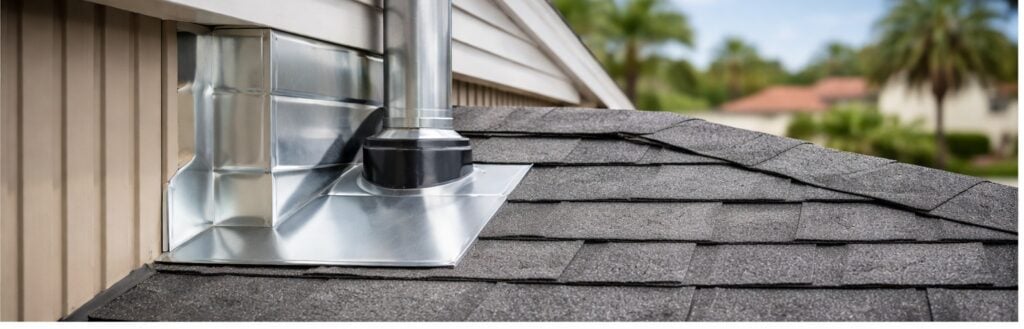
- Pipe penetrations (plumbing stacks, bathroom vents, HVAC)
- Skylights and sun tunnels
- Eaves/rakes at the roof edge (drip edge + starter interface)
- Dormers and dead valleys behind them
- Transitions between roof sections with different slopes or materials
If a contractor skips flashing upgrades in these areas, the “brand new roof” can still be a future leak project.
Common Types of Roof Flashing Homeowners Hear About
You’ll see different names depending on the roof and the intersection. The big ones:
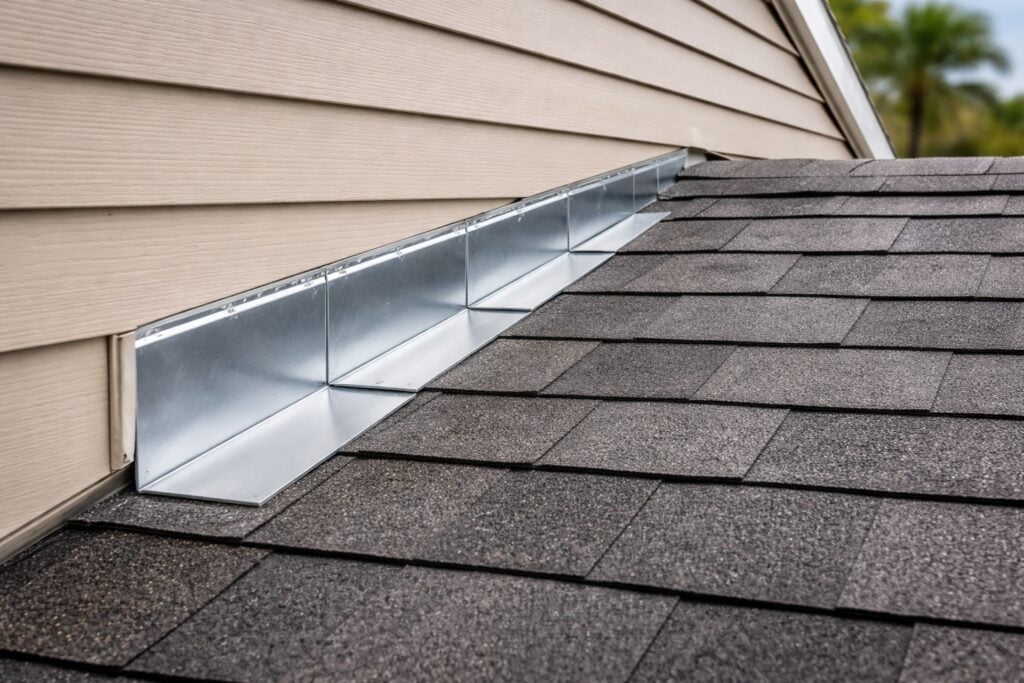
- Apron flashing: An “L” style flashing at the base of a wall or penetration (often used at the lower side of chimneys and dormers).
- Step flashing: Individual pieces layered with each shingle course along a sidewall or chimney.
- Counter flashing: A cover flashing that typically gets cut into mortar joints or integrated into wall systems to protect the top edge of step/apron flashing.
- Valley flashing: Metal lining in open valleys (or reinforced valley protection, depending on the roof type).
- Kickout flashing: A diverter at the bottom of a roof-to-wall run that kicks water into the gutter instead of behind stucco/siding. This detail is famously missed and causes ugly rot.
Florida roof assemblies also commonly involve drip edge, pipe boots, and storm collars, which aren’t always called “flashing” in casual conversation but serve the same water-control purpose.
Does Flashing Get Replaced During a Roof Replacement?
In Tampa Bay, the safest expectation is that flashing should be replaced or upgraded in most roof replacements, especially in areas with a history of leaks, visible corrosion, prior repairs, or questionable workmanship.
That said, there are situations where some flashing could be reused. The real answer is not “always” or “never.” It’s: replace what’s risky, keep only what’s proven and compatible, and don’t build a new roof on someone else’s shortcuts.
Many contractors default to reuse because it lowers the estimate and speeds up installation. That’s not the same thing as “best practice.”
When Reusing Flashing Is Actually Reasonable
Reusing flashing can be acceptable when all of this is true:
- It’s the right type for the detail (proper step flashing, correct wall integration, correct laps)
- No rust, pitting, pinholes, cracks, or oil-canning
- No deformation from previous tear-offs, foot traffic, or “flattened” bends
- Fastener holes aren’t wallowed out and the metal hasn’t been Swiss-cheesed by re-nailing
- It’s compatible with the new roof system (underlayment, shingle profile, exposure, and slope)
- The contractor is willing to warranty it like new work, not with a disclaimer
Even then, reuse is usually limited to select pieces in low-risk locations. High-risk intersections (chimneys, walls, valleys, penetrations) are rarely worth gambling on.
When Flashing Should Be Replaced No Matter What
If any of these show up, replacement is the smart move:
- Corrosion (including “light surface rust” on galvanized that’s already started)
- Previous leaks at that location (water stains, soft decking, moldy sheathing)
- Old sealant blobs or tar patches (signals a failed detail, not a “fix”)
- Improper step flashing (continuous L-flashing where step flashing is needed)
- Missing kickout flashing at roof-to-wall-to-gutter intersections
- Chimney flashing that depends on caulk as the primary water seal
- A roof material change (new shingle type, new exposure, switching systems)
- Multiple roof layers previously (flashing often gets buried, bent, and compromised)
If you’re paying for a full replacement, keeping compromised flashing is like putting bald tires on a new truck.
The Tampa Bay Flashing Problems That Cause the Most Leaks
These are repeat offenders in Florida homes:
1) Stucco sidewalls with no proper kickout
Water runs down the wall line, slips behind stucco, and rots framing. The leak can show up far from the cause.
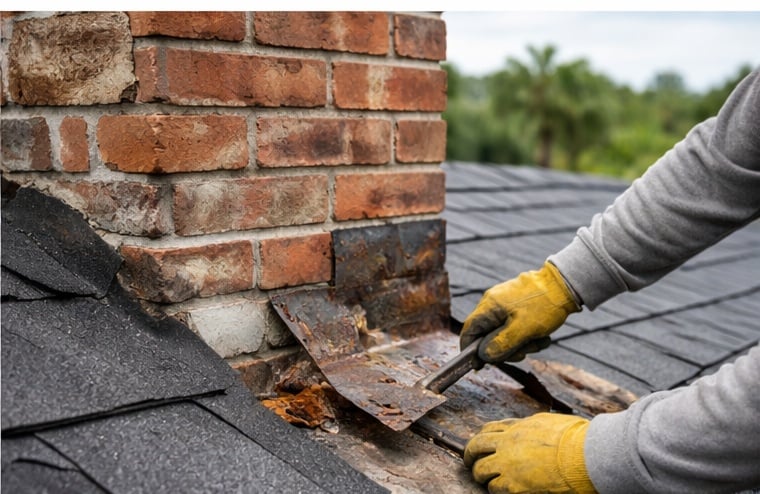
2) Chimneys with “caulk-only” counter flashing
Masonry expands, contracts, and cracks. If the detail relies on sealant to do all the work, it eventually loses. Step + counter flashing needs real integration, not just a bead.
3) Valleys overloaded by fast runoff
Tampa downpours push huge volumes of water through valleys. Weak underlayment, sloppy valley cuts, or wrong metal width get exposed fast.
4) Pipe penetrations with cracked boots
Rubber boots bake in the sun. If they’re old, brittle, or installed with exposed fasteners in the wrong spot, they become drip factories.
5) Drip edge skipped or installed incorrectly
Edge metal matters more than people think. Bad edge detailing can wick water into fascia, rot sheathing edges, and stain soffits.
Florida Code and Manufacturer Rules: Flashing Isn’t a “Preference”
Roof covering work is generally required to follow code and manufacturer instructions, and flashing requirements are explicitly addressed in residential roofing sections.
Translation for homeowners: if a contractor wants to wing it with homemade metal shapes, random sealants, or “this is how we’ve always done it,” that’s not a flex. It’s a risk.
Best Flashing Materials for Tampa Bay Homes
Material choice should match the environment, roof type, and budget. The most common:
- Galvanized steel: widely used, cost-effective, strong. Quality and coating matter.
- Aluminum: lightweight and corrosion-resistant, but it can dent and isn’t ideal everywhere.
- Copper: premium, long service life, looks great, develops patina. Copper sheet for building construction commonly aligns with ASTM standards used for roofing and flashing applications.
- Stainless steel: excellent corrosion resistance (often used in harsh coastal environments), higher cost.
Two Tampa Bay-specific warnings:
- Salt exposure changes the math. Coastal air can chew through low-grade or thin metals faster than homeowners expect.
- Mixed metals can backfire. Some combinations accelerate galvanic corrosion. If you go copper in one area and aluminum nearby, you want a contractor who understands isolation and compatibility, not “close enough.”
What “Good Flashing Work” Looks Like on a Roof Replacement
A solid flashing install is boring to look at, and that’s the point. These are the signs that the details were actually built right:
- Layering is shingle-style: every lap sheds water naturally, not “sealed” into submission
- Step flashing is individual pieces woven with each shingle course, not one long strip pretending to be step flashing
- Counter flashing is truly protecting the top edge and is integrated into the wall/chimney system, not just caulked on
- Valleys have the correct width and underlayment support for the roof type and water volume
- Pipe boots are new and fastened/sealed correctly for the shingle system
- Kickout flashing exists where it should, and it actually kicks water into the gutter
- Fasteners are placed where they won’t cause leaks and are compatible with the metal
If the “waterproofing strategy” is mostly sealant, that’s not a strategy. That’s hope.
Questions to Ask Your Roofer Before You Sign a Roof Replacement Contract
Use these to smoke out vague estimates and “we’ll see” language:
- Which flashing is included as new, and which (if any) is being reused?
- Are chimney, wall, and pipe flashings included, or only replaced “if needed”?
- Will you install kickout flashing where roof lines die into a wall near gutters?
- What metal are you using, and is it appropriate for coastal exposure if applicable?
- How are you handling stucco/wall integration details (step + counter, not caulk-only)?
- Does the workmanship warranty cover flashing leaks the same way it covers shingle leaks?
- Will you replace any damaged decking found at flashing-leak zones before reinstalling the details?
If answers are fuzzy, the leaks later won’t be.
Cost Reality: Why Flashing “Adds Up” and Why It’s Still Worth It
Flashing can get expensive because it’s labor- and detail-intensive. A roof can have dozens (or hundreds) of step flashing pieces, multiple penetrations, and complex wall conditions.
But here’s the math homeowners actually live with:
- Skipping $600 to $2,500 worth of correct flashing work can easily become thousands more in interior repairs, mold remediation, soffit/fascia replacement, and repeated service calls.
- Leaks at wall lines and chimneys don’t stay small. Water travels.
A roof replacement is the one moment when access is easy. Fixing flashing later is always more disruptive, more expensive, and more likely to involve tearing into finished areas.
Tampa Bay Homeowner Checklist: What to Inspect After the Roof Is Done
Right after installation (and after the first heavy rain), walk the perimeter and look for:
- Clean, consistent wall flashing lines (no big gaps, no wavy metal, no random tar smears)
- Chimney flashing that looks integrated, not just sealed
- Valleys that look straight and intentional, with clean cuts and no exposed underlayment
- Pipe boots are seated flat with no obvious cracking, tearing, or lifted edges
- No staining at soffits/fascia and no water trails on walls
- Gutters receiving water properly at the roof-to-wall ends (kickout doing its job)
Inside the house, check the attic (if accessible) for:
- damp decking near chimneys, valleys, and penetrations
- fresh water staining on rafters or trusses
- wet insulation
Catching a bad flashing detail early is cheaper than discovering it after a storm season.
CONCLUSION
Roof flashing should usually be replaced or upgraded during a roof replacement in Tampa Bay, as it’s the difference between a roof that looks new and one that stays watertight. Reuse only makes sense when the metal is proven, compatible, and the installer is willing to warranty it like new. For Florida rain, wind, heat, and coastal corrosion, flashing is not the place to “save a little” and pay for it later.
Read our blog: “Shingle Brand vs Roofing Contractor in Tampa Bay: What Matters Most for a Roof That Lasts.”