
At Steadfast Roofing, a Florida roofing contractor based in Ruskin, FL, we consider roof underlayment one of the most important water-control components in a roofing system. Shingles, metal panels, and tiles provide the primary exterior covering, but underlayment protects the roof deck when wind-driven rain enters through damaged roofing materials, lifted edges, failed flashing, or storm-created openings.
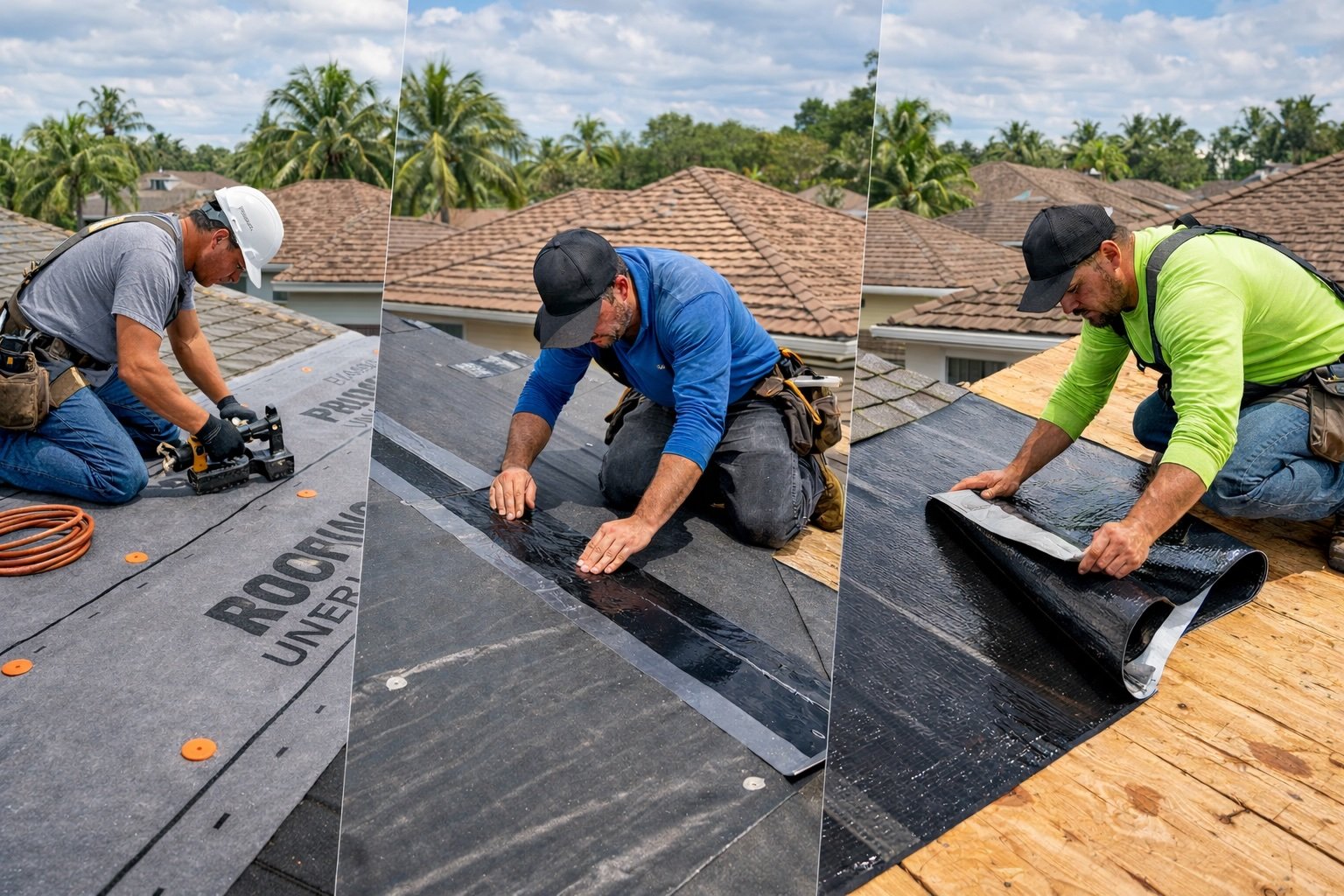
Florida homeowners generally encounter three underlayment installation methods during a roof replacement: full peel-and-stick membrane, roof-deck seam tape combined with synthetic underlayment, and a two-layer mechanically fastened synthetic system. Each method can provide effective protection when it is compatible with the roof covering, installed over a properly prepared deck, and secured according to current Florida code and product-approval requirements.
What Roof Underlayment Does in Florida
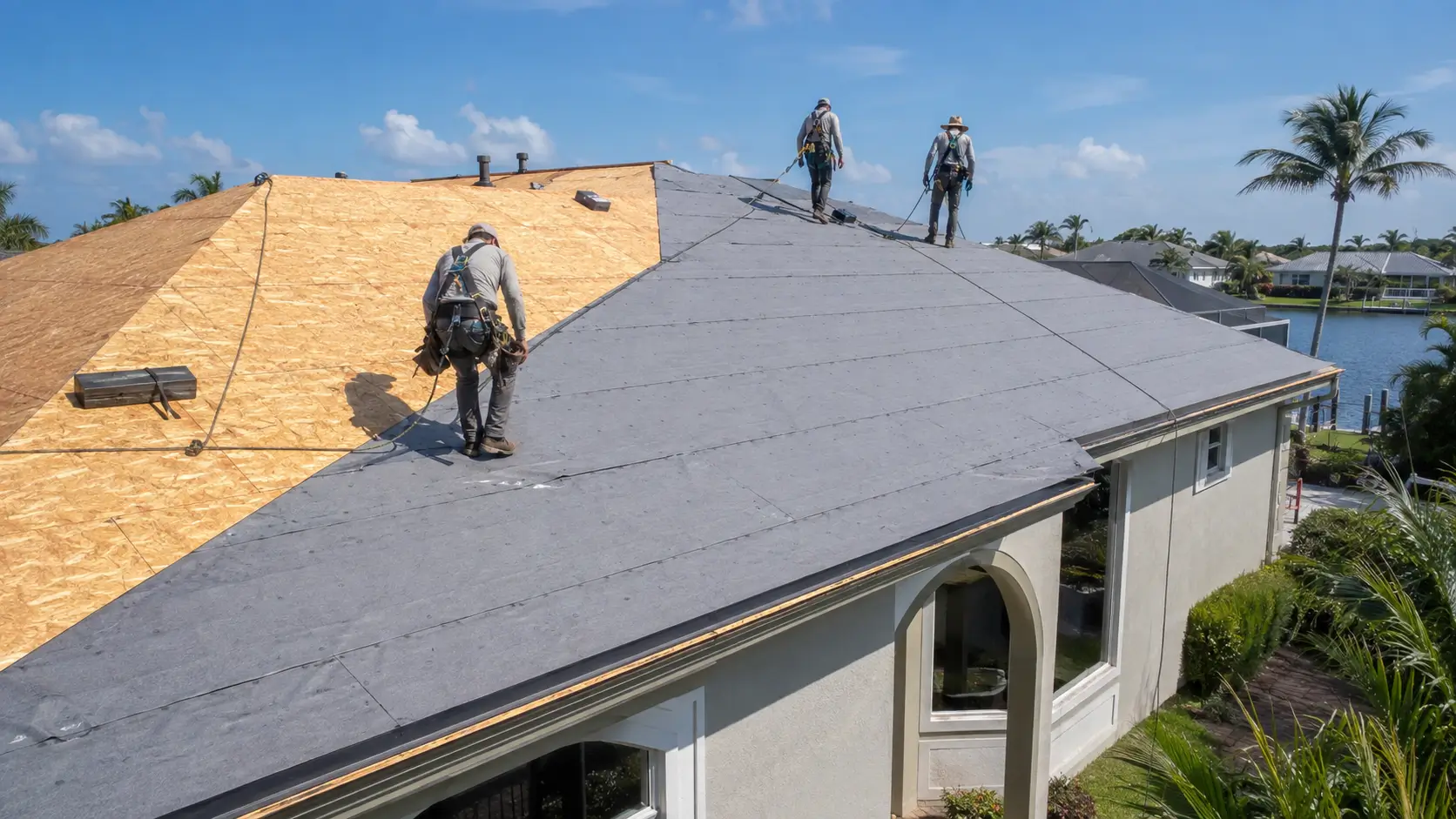
Roof underlayment is installed between the structural roof deck and the finished roofing material. Its main purpose is to redirect water that passes beneath shingles, panels, or tiles before that moisture reaches plywood, oriented strand board, insulation, ceilings, and interior finishes.
This secondary protection is especially important in Florida because roofs are regularly exposed to intense rain, high winds, heat, humidity, and tropical weather. Wind-driven rain does not always move straight down the roof. It can travel upward beneath shingle edges, enter around flashing, or move laterally through damaged roof sections.
A properly installed underlayment system can reduce water intrusion when the primary covering is damaged or temporarily removed. The Florida Building Commission has emphasized that sealed roof-deck systems can substantially limit water infiltration after the loss of the exterior roof covering.
Underlayment is not a substitute for shingles, metal roofing, flashing, or professional roof repair. It is a backup layer designed to protect the building until the primary problem can be corrected.
Florida Roof Underlayment Code Requirements
Florida roofing requirements depend on the roof slope, roof-covering type, deck construction, product approval, installation method, and project location. The primary underlayment provisions in the Florida Residential Code generally apply to roofs with slopes of 2:12 or greater.
Current code provisions recognize several compliant approaches, including a self-adhering membrane installed across the entire roof deck, self-adhering strips placed over roof-deck joints beneath an approved underlayment, and a two-layer mechanically fastened system.
Synthetic underlayment must comply with the appropriate material standard and be included in an approved roofing assembly. Installation must also follow the manufacturer’s instructions and the product’s Florida approval.
Tile roofs have additional system-specific requirements, while projects located within the High-Velocity Hurricane Zone are subject to separate provisions. The permitted assembly should therefore be confirmed for the specific property rather than selected only by product name or price.
Full Peel-and-Stick Roof Underlayment
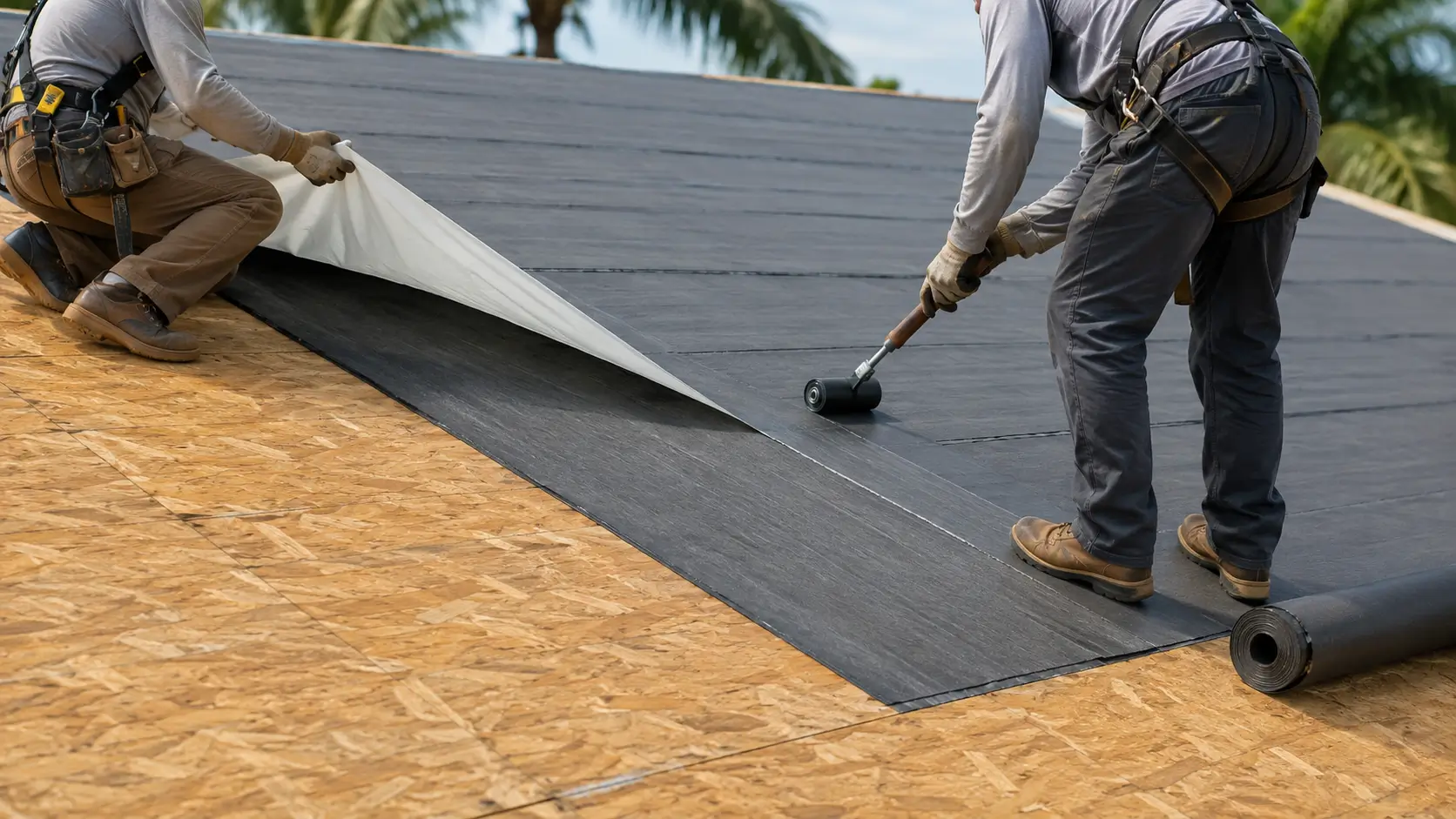
Full peel-and-stick installation uses a self-adhering polymer-modified membrane across the entire prepared roof deck. Unlike mechanically fastened underlayment, the membrane bonds directly to the decking and creates a more continuous water-control layer.
Because the material adheres across the roof surface, water has fewer opportunities to travel beneath it. Many peel-and-stick membranes also seal around roofing fasteners, helping reduce leakage through penetrations if the finished covering becomes damaged.
This method is commonly considered for roofs with multiple valleys, dormers, wall intersections, penetrations, or complicated transitions. It may also be suitable for homes exposed to severe wind-driven rain or for homeowners who want a highly continuous secondary water barrier beneath an approved asphalt shingle roofing system or metal roofing system.
The roof deck must be clean, dry, stable, and free from dust, moisture, protruding fasteners, old felt, and loose debris. Some deck surfaces or products may require primer to achieve proper adhesion. Installing the membrane over damp, deteriorated, or contaminated decking can create weak areas that do not remain bonded.
Peel-and-stick must also be installed without wrinkles, trapped air, fish-mouths, or unsupported areas over deck gaps. Incorrectly formed laps can create pathways that direct water beneath the membrane instead of toward the roof edge.
A fully adhered membrane offers strong water protection, but it can make future roof-deck replacement more labor-intensive because the material bonds directly to the plywood or OSB. It can also reduce outward drying through the roof deck, which makes proper attic ventilation and indoor moisture control particularly important.
Roof-Deck Seam Tape With Synthetic Underlayment
The seam-tape method is frequently misunderstood. It does not refer only to taping the overlaps between sheets of synthetic underlayment.
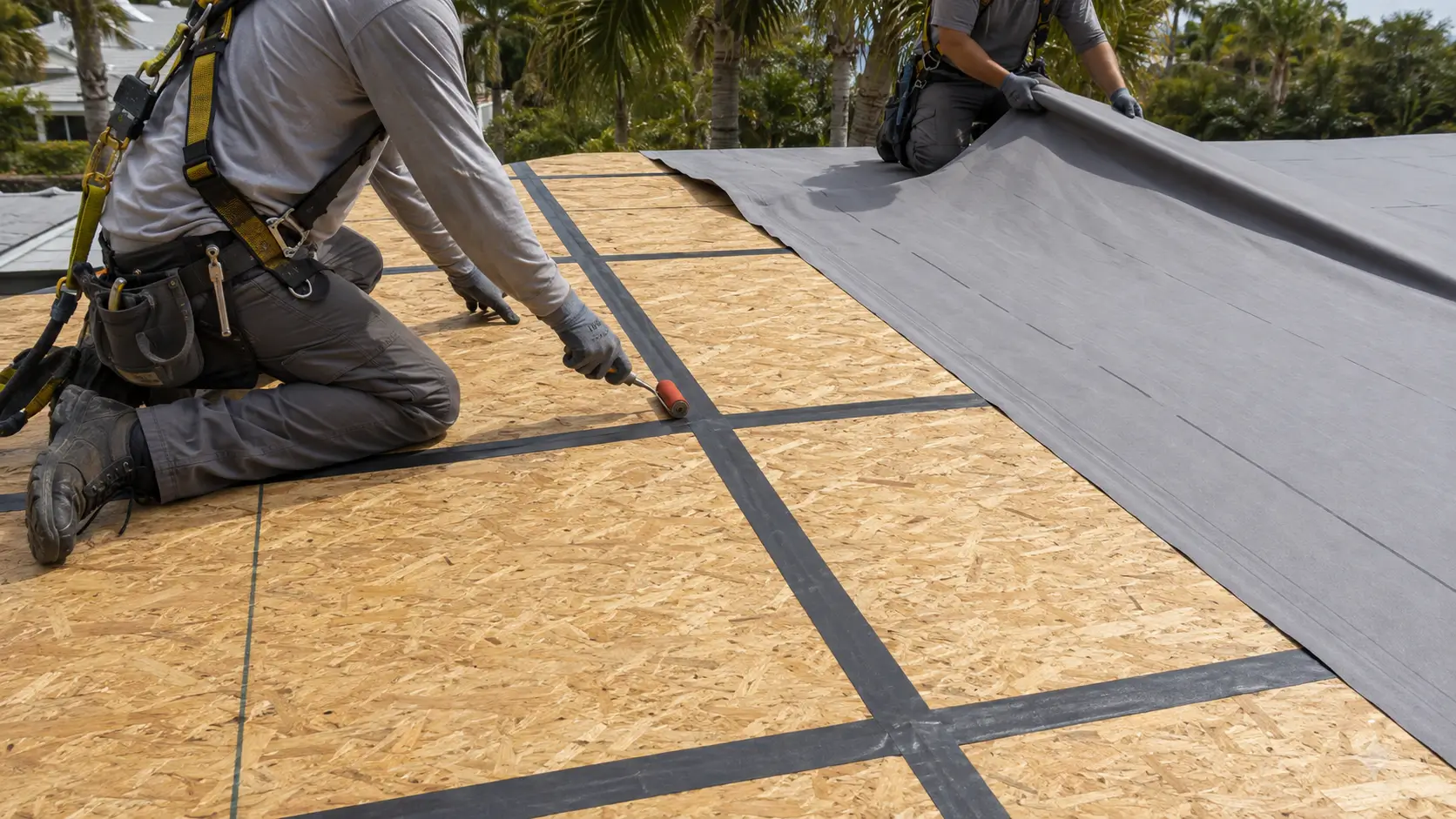
In a code-recognized sealed-deck assembly, self-adhering strips are installed directly over the joints between plywood or OSB roof-deck panels. An approved synthetic or other compliant underlayment is then installed over the taped deck and mechanically fastened.
Roof-deck joints are predictable leakage points. If shingles and field underlayment are damaged during a storm, water may enter the narrow spaces between deck panels and reach the attic. Sealing those joints creates a secondary barrier beneath the field underlayment.
This system combines two forms of protection. The synthetic underlayment sheds water across the roof surface, while the seam tape protects the deck joints if the field material becomes torn, punctured, or displaced.
Seam tape can provide a practical balance between water protection and future serviceability. Unlike full peel-and-stick, it does not bond a membrane to every square foot of decking. This may make future tear-off and deck repairs easier while still providing targeted protection over vulnerable panel joints.
Successful installation requires every joint to be identified and sealed, including short joints, repaired deck sections, T-joints, and newly installed panels. The tape must be centered over each seam and pressed firmly against clean, dry decking.
Missing even a small section can interrupt the sealed-deck system. Poor adhesion, wet plywood, incompatible tape, trapped debris, or inadequate pressure during installation can also reduce performance.
The synthetic underlayment installed above the tape must still have correct laps, fastener spacing, and edge attachment. Seam tape cannot compensate for loose fasteners, damaged sheets, incorrect flashing, or poorly integrated roof penetrations.
Two-Layer Synthetic Roof Underlayment
The third common method uses two layers of approved synthetic underlayment installed with code-compliant laps and mechanical fastening.
A two-layer system does not mean placing two loose sheets directly on top of each other. The courses must be positioned and offset so they form a water-shedding assembly. The required overlap, exposure, fastening pattern, and end laps depend on the selected material, roof slope, manufacturer’s instructions, and approved roofing system.
Synthetic underlayment is generally lighter and more tear-resistant than traditional asphalt-saturated felt. It can provide a clean installation surface and may remain more stable during roofing work when correctly fastened.
Cap nails are commonly used because their wider heads distribute pressure across a larger section of the underlayment. Bare fasteners or improperly driven nails can tear the material, create enlarged holes, or allow sheets to lift during windy conditions.
Two-layer synthetic underlayment is often appropriate for straightforward roof designs with adequate slope and limited complexity. When installed correctly, it provides effective water-shedding performance and may be easier to remove during a future reroof than a fully adhered membrane.
Its primary limitation is that it remains mechanically attached rather than continuously bonded to the roof deck. If the sheets are torn, incorrectly lapped, poorly fastened, or displaced, water may reach fastener penetrations and deck joints beneath the material.
Which Florida Underlayment Method Is Best?
There is no single underlayment method that is automatically best for every Florida home.
Full peel-and-stick usually provides the most continuous deck coverage and is often considered for complicated roofs or properties with greater exposure to wind-driven rain. Seam tape with synthetic underlayment offers direct protection over roof-deck joints while preserving easier future access to much of the decking. A two-layer synthetic system can provide dependable performance for less complicated roof designs when laps and fastening are completed correctly.
The right choice depends on the roof slope, deck condition, roofing material, number of valleys, penetration details, ventilation, local wind exposure, manufacturer requirements, and planned service life of the roof.
Before beginning a residential roof replacement, homeowners should know which underlayment product will be used, how many layers will be installed, whether deck joints will be sealed, and how valleys and penetrations will be protected.
The proposal should identify the product rather than relying on vague descriptions such as “upgraded underlayment” or “waterproof barrier.” Product approval, material standard, installation method, and compatibility with the finished roof covering are more meaningful than marketing terminology.
Installation Details That Affect Performance
Even a high-quality underlayment can fail when the roof deck and flashing details are not prepared correctly.
Soft, delaminated, damaged, or inadequately attached decking must be repaired before underlayment is installed. Covering deteriorated wood does not restore its structural capacity or provide a suitable attachment surface. A professional roof inspection can identify many visible problems, although some hidden damage may not become apparent until the old roofing materials are removed.
Valleys require particular attention because they carry more water than most other areas of the roof. Valley membrane must be centered, properly lapped, and integrated with the field underlayment and finished roof covering. Wrinkles or poorly formed transitions can concentrate water in exactly the area that requires the most protection.
Underlayment must also integrate correctly with the drip edge. At roof edges, the sequence of the metal and underlayment determines whether water exits over the exterior surface or moves behind the fascia.
Pipe boots, vents, chimneys, skylights, headwalls, and sidewalls interrupt the roof plane. The underlayment and flashing around these areas must be layered so upper components drain over lower components. Roofing sealant may support a properly flashed assembly, but it should not replace mechanical flashing and correct water-shedding overlaps.
Underlayment should not remain exposed longer than permitted by the manufacturer. Sunlight, heat, wind, construction traffic, and repeated rain can damage uncovered materials. Any torn, wrinkled, or punctured sections should be corrected before the finished roofing system is installed.
Choosing Underlayment for a Florida Roof Replacement
For a simple shingle roof with adequate slope, two-layer synthetic underlayment may provide an efficient and code-compliant solution. For a roof where deck-joint leakage is a major concern, seam tape beneath synthetic underlayment provides a targeted sealed-deck system. For complex rooflines or homeowners seeking the most continuous secondary water barrier, full peel-and-stick may be the preferred option.
The selected method must work as part of the complete roof assembly. Underlayment cannot correct poor deck attachment, inadequate flashing, improper ventilation, incompatible materials, or installation errors in the finished roof covering.
Homeowners planning a roof replacement in Tampa or another storm-exposed Florida community should compare complete installation specifications rather than choosing a contractor based only on the visible shingles or quoted price.
Conclusion
Florida roof underlayment is a complete water-control system rather than a simple sheet installed beneath the visible roof. Full peel-and-stick creates the most continuous adhered layer, seam tape protects vulnerable roof-deck joints beneath mechanically fastened underlayment, and two-layer synthetic relies on precise lapping and secure attachment.
Steadfast Roofing evaluates the roof deck, slope, geometry, roofing material, flashing details, ventilation, and product approvals before recommending an underlayment assembly. Homeowners preparing for a reroof can contact our roofing team to discuss the most appropriate system for their property.
Frequently Asked Questions
Is peel-and-stick underlayment required on every Florida roof?
No. Florida code recognizes several compliant underlayment methods, including full self-adhering membrane, sealed roof-deck joints with approved underlayment, and two-layer mechanically fastened systems. The permitted method depends on the roof covering, slope, location, product approval, and applicable code requirements.
Is seam tape the same as taping synthetic underlayment overlaps?
No. In a sealed roof-deck system, seam tape is installed directly over the joints between plywood or OSB panels. The field underlayment is then installed above the taped deck. Taping only the overlaps between underlayment sheets does not create the same assembly.
Which roof underlayment provides the best protection in Florida?
Full peel-and-stick generally provides the most continuous secondary water barrier because it adheres across the entire roof deck. However, seam tape with synthetic underlayment and properly installed two-layer synthetic systems can also provide strong protection. The best option depends on the roof design, deck condition, exposure, finished roofing material, and installation quality.