
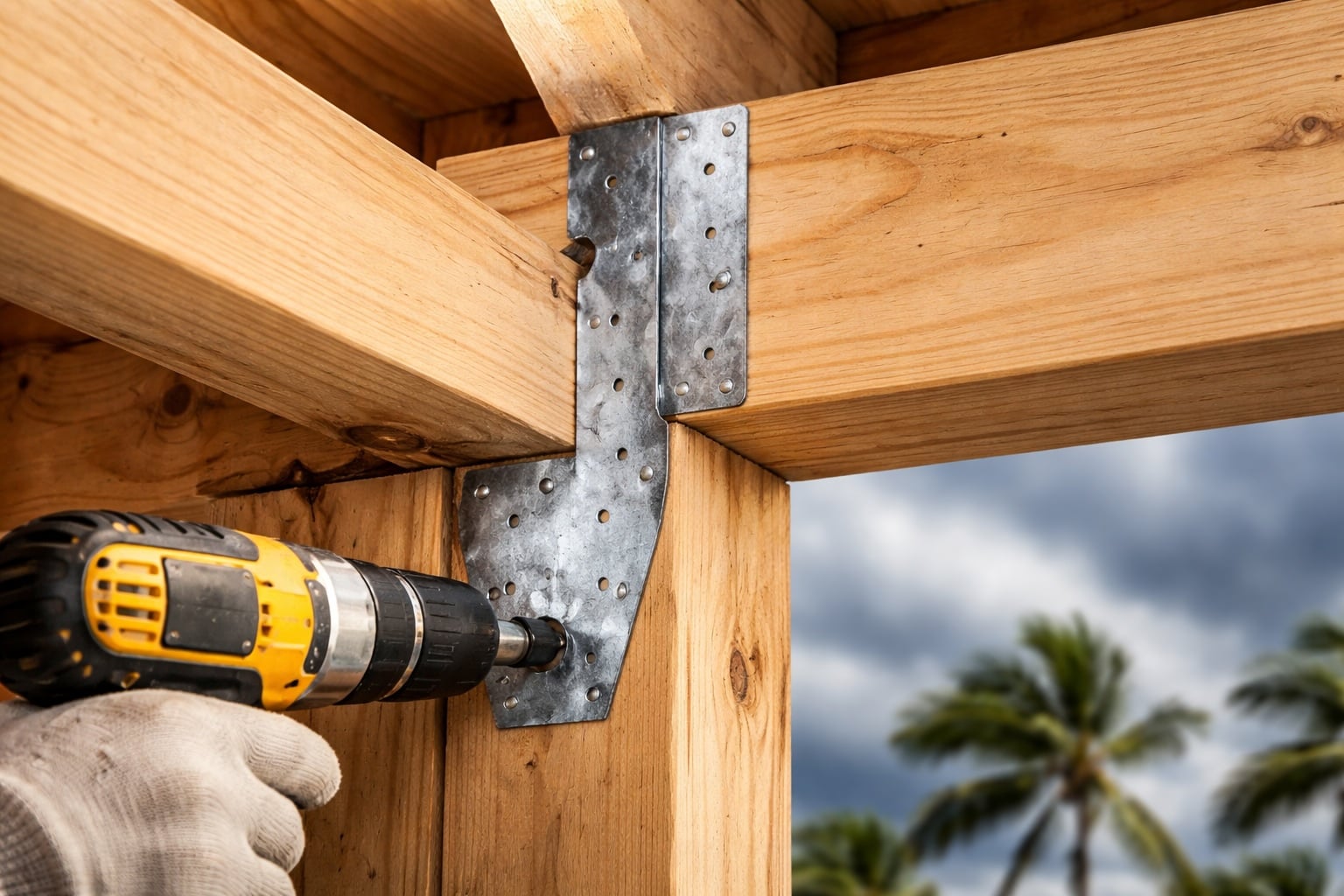
For Tampa homeowners, hurricane straps are part of the structural load path that helps transfer wind-uplift forces from rafters or trusses into the wall system. At Steadfast Roofing, we evaluate these connections alongside the roof assembly, permitting requirements, reroof scope, and wind-mitigation documentation so homeowners can distinguish a structural upgrade from an insurance-credit assumption.
What Hurricane Straps and Roof-to-Wall Connections Do
High winds can create uplift that tries to separate roof framing from exterior walls. Roof-to-wall connectors resist that force at the truss-or-rafter-to-wall intersection. The connection may consist of toenails, metal clips, single wraps, double wraps, or an engineered structural connection.
“Hurricane strap” is often used generically, but the exact configuration matters on a Florida wind mitigation report. A connector that is present but lacks required fastening, has severe corrosion, or is poorly positioned may not qualify in the stronger category a homeowner expects.
Florida Roof-to-Wall Code Rules During Reroofing
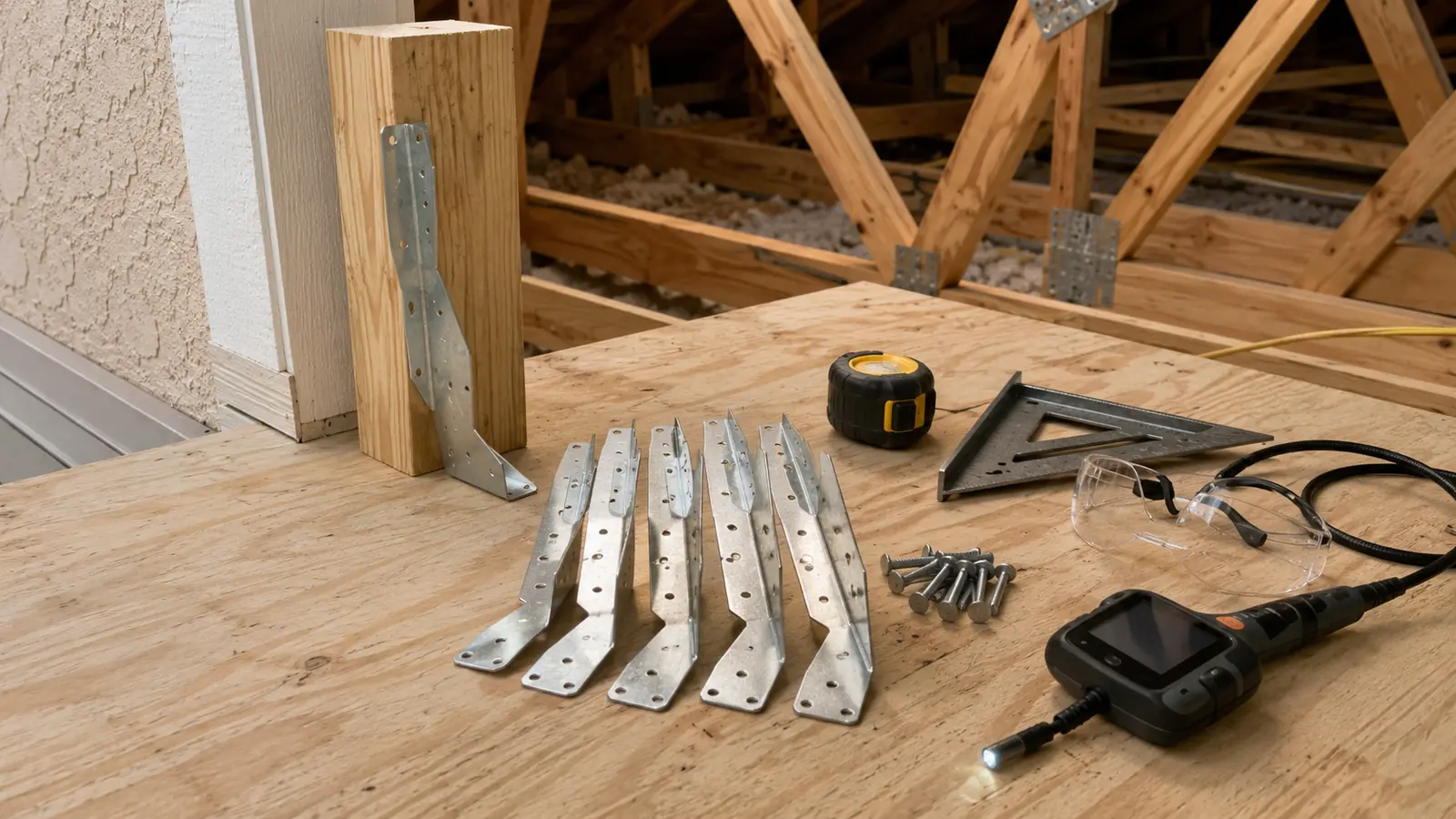
The current Florida Building Code, Existing Building, Section 706.8 can trigger roof-to-wall improvements when an existing qualifying roof covering is removed and replaced. Conditions include location in the wind-borne debris region and an insured value of at least $300,000, or a qualifying just valuation when insured-value documentation is unavailable. The code limits mandated roof-to-wall retrofit work so it is not required beyond a 15% increase in reroofing cost, with additional exceptions and prescriptive provisions.
This does not mean every Tampa roof replacement automatically requires new straps. Applicability depends on the building, roof deck, permit history, valuation, wind-borne-debris classification, existing connections, and permitted scope. A Tampa roof replacement should therefore be evaluated before assuming structural connector work is mandatory or included.
Why a New Roof Does Not Automatically Mean New Hurricane Straps
Reroofing and roof-to-wall retrofitting are separate scopes. A reroof can involve removal of the covering, deck repairs, underlayment, flashing, ventilation details, and installation of the new roof system. Roof-to-wall strengthening may require access through the attic, soffit, eave, or opened roof deck and may require different hardware or engineering.
Before construction, a roof inspection in Tampa can help identify the existing connector type so the reroof and any structural retrofit can be coordinated.
Hurricane Clips, Single Wraps, and Double Wraps on Wind Mitigation Reports
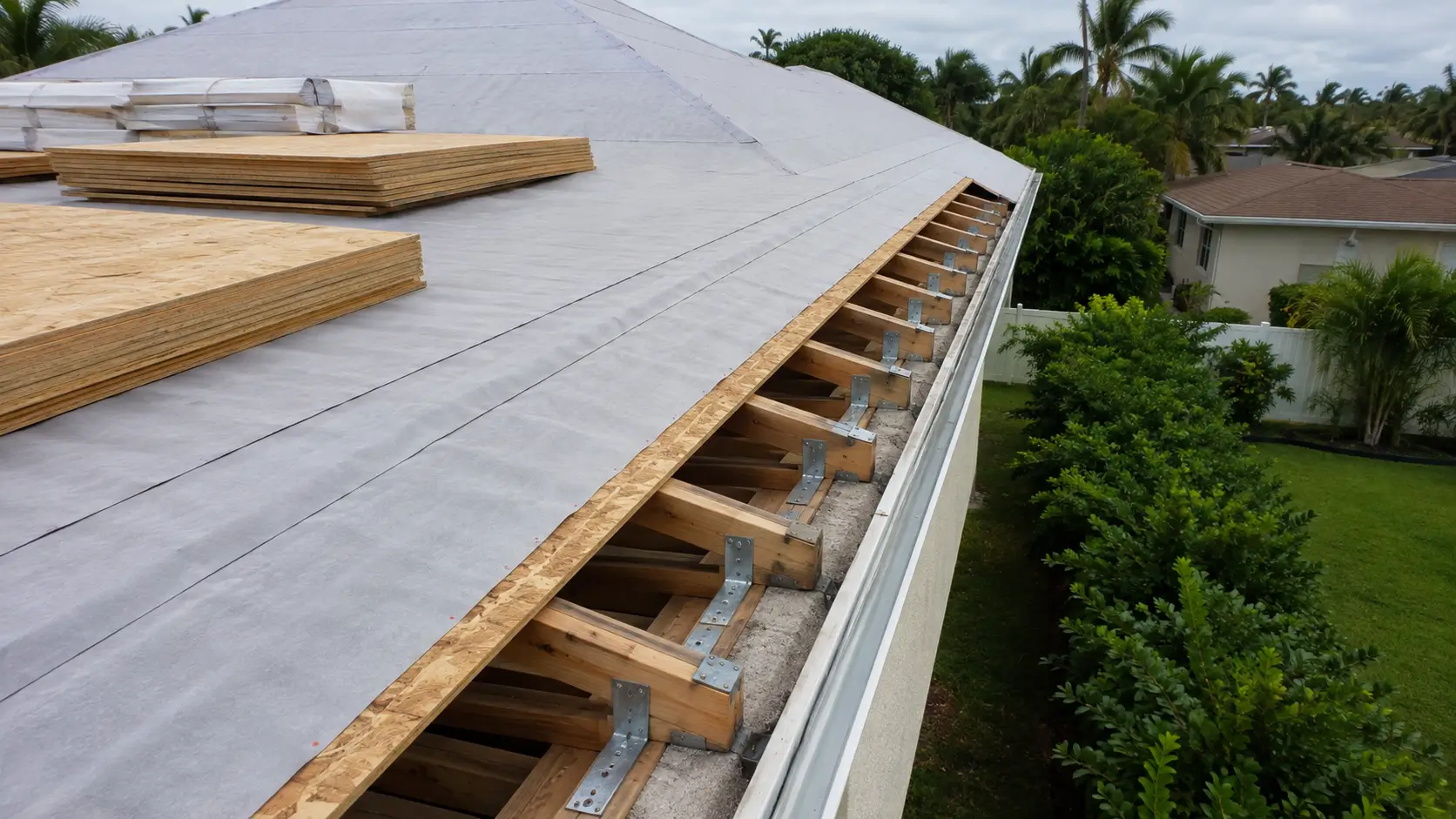
Florida’s Uniform Mitigation Verification Inspection Form evaluates the weakest roof-to-wall connection. For metal connectors to meet the form’s minimum conditions for clip or wrap categories, visible connectors must be secured to the truss or rafter with at least three nails and properly attached at the wall connection, while also meeting positioning and corrosion conditions.
| Connection Type | Wind-Mitigation Distinction |
| Toenails | Angled nails connect the truss or rafter to the top plate; nonqualifying metal connectors can also fall into this category. |
| Clips | Metal connectors that do not properly wrap over the truss or rafter. |
| Single wraps | One strap wraps over the truss or rafter and meets the required nail-position pattern. |
| Double wraps | Two qualifying straps, or a qualifying wrap arrangement secured on both sides. |
My Safe Florida Home’s current roof-to-wall guidance states that qualifying work must be completed at every truss or rafter for windstorm-mitigation credit and repeats the minimum three-nail condition for new connectors.
How Hurricane Straps Can Affect Florida Insurance Discounts
Florida law requires residential property insurance rate filings to account for windstorm-mitigation features. The actual premium change is not a fixed statewide percentage; it depends on the insurer’s filed credits, the home’s mitigation features, and what the inspection documents.
The practical sequence is to identify the current roof-to-wall category, ask the insurer how a better category affects the specific policy, complete qualifying work, and obtain an updated mitigation inspection with clear documentation.
This distinction matters because simply adding hardware does not guarantee a premium reduction. The completed connection must satisfy the inspection criteria, and the resulting classification must produce a credit under that insurer’s rating structure.
My Safe Florida Home Grants for Roof-to-Wall Strengthening
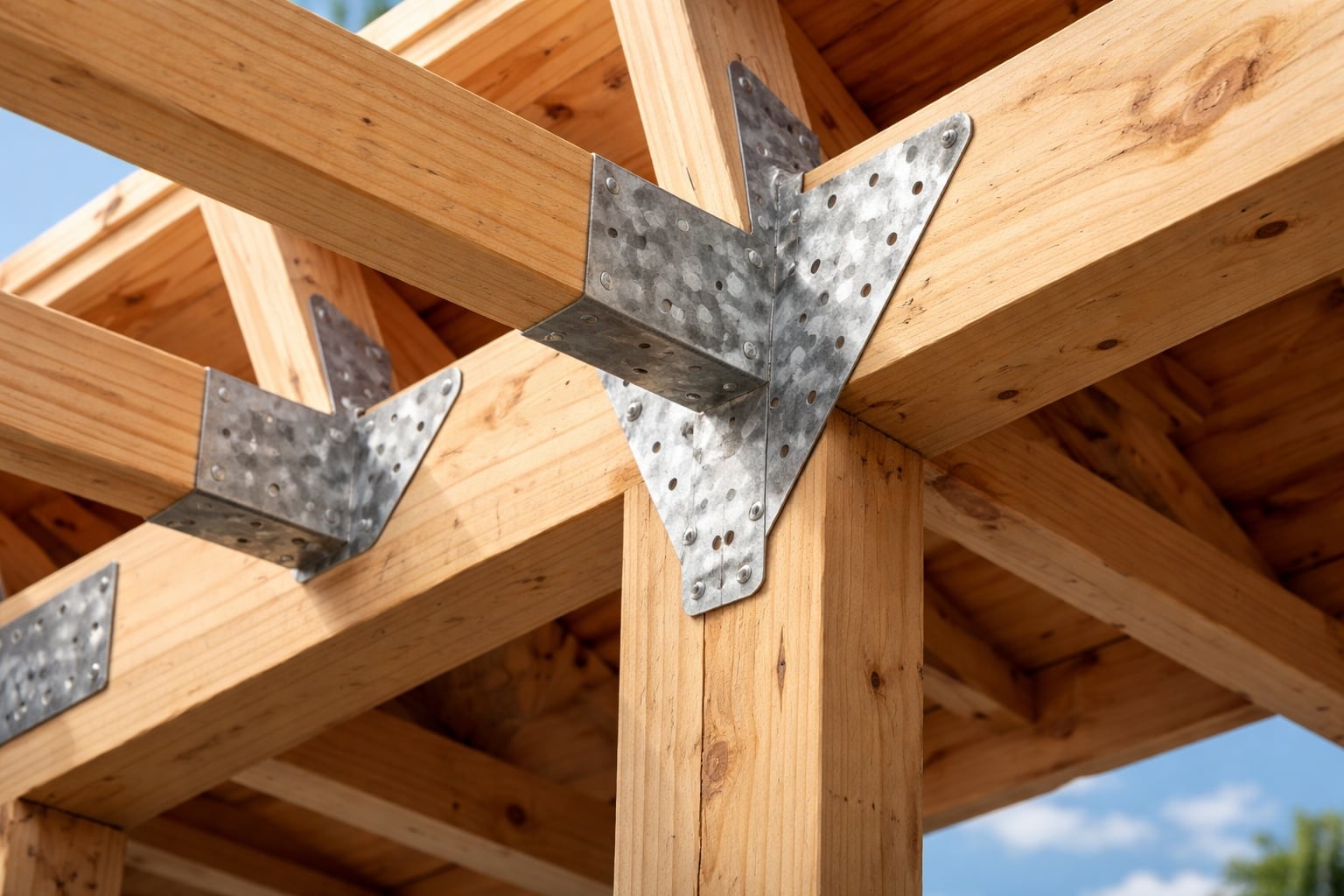
The My Safe Florida Home program currently lists roof-to-wall reinforcement as an approved mitigation category and offers qualifying homeowners free wind-mitigation inspections and potential grant assistance of up to $10,000.
Matching grants reimburse up to two-thirds of eligible project cost, capped at a $10,000 state contribution. Eligible low-income grants can provide up to $10,000 without a homeowner match, subject to funding and approval.
An approved $6,000 project, for example, could produce a $4,000 reimbursement and a $2,000 homeowner share under the matching-grant structure.
Current grant eligibility also includes an initial program inspection, an insured dwelling value of $700,000 or less, and an original building-permit application before January 1, 2008, along with other program requirements.
Homeowners considering state funding can review our detailed guide to the My Safe Florida Home Grant in Tampa before authorizing work when program reimbursement is part of the budget.
The 2026 Federal Tax Credit Truth About Hurricane Straps
Hurricane straps should not be budgeted as a 2026 federal Energy Efficient Home Improvement Credit.
The IRS Energy Efficient Home Improvement Credit applied to qualifying improvements placed in service through December 31, 2025. Its listed categories centered on energy-efficiency measures such as insulation, certain windows and doors, heat pumps, and specified residential energy property. Hurricane straps are structural wind-mitigation hardware, not a listed Section 25C qualifying improvement.
Other tax consequences can depend on individual circumstances, but a hurricane-strap retrofit should not be sold or budgeted as carrying a standard federal energy tax credit.
How We Recommend Planning a Hurricane-Strap Retrofit in Tampa
We start with documentation: determine the current connector type, confirm whether the reroof triggers structural requirements, and identify whether the project is intended to improve a wind-mitigation classification, satisfy code, qualify for a grant, or accomplish all three.
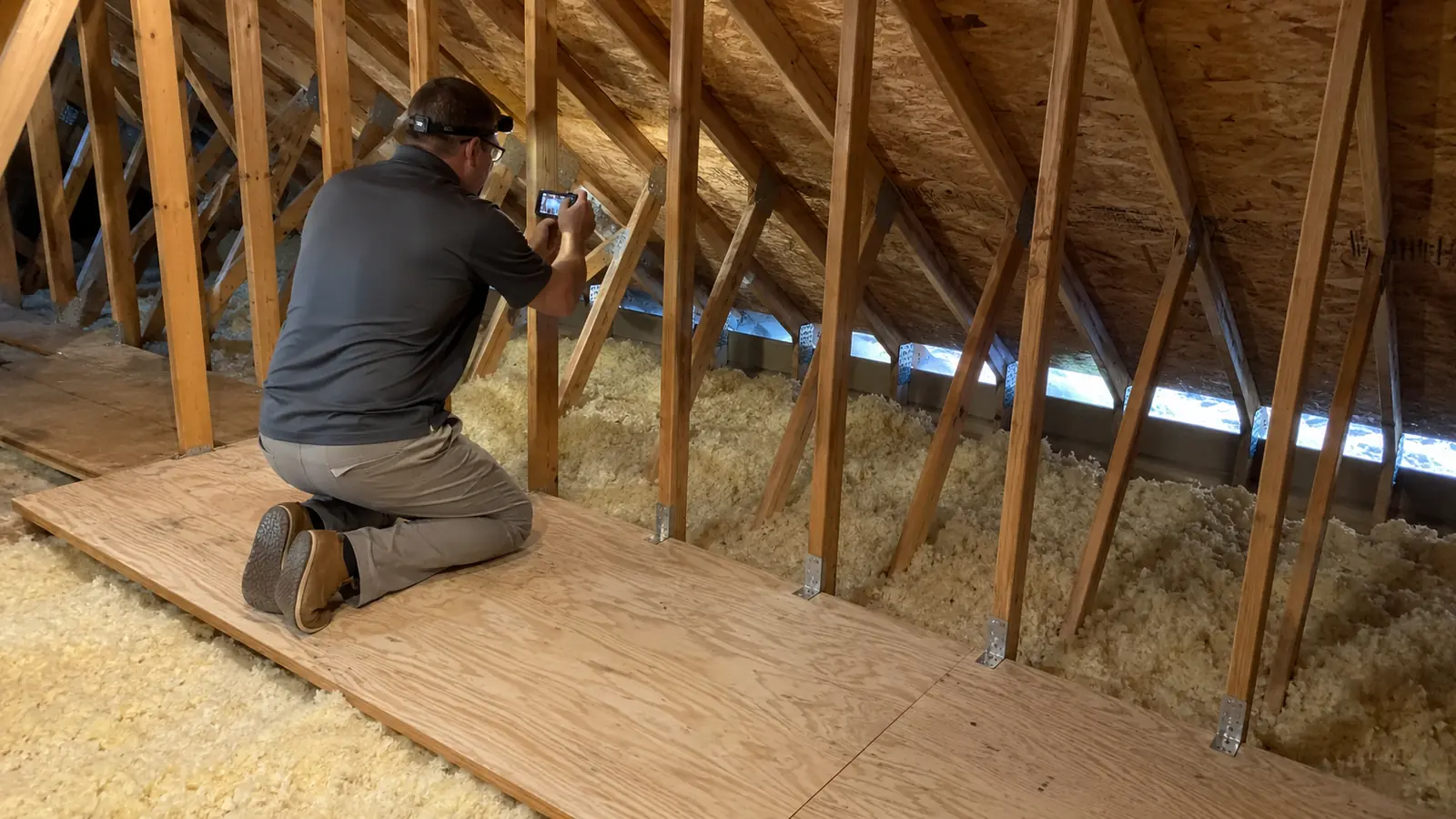
The installation method must match the framing. Access may come from the attic, soffit or eave, or roof deck. Connector selection, fastener schedule, wood condition, clearances, and attachment to the wall or bond beam all matter.
When structural improvements are coordinated with Tampa roofing, planning before final roof installation can reduce rework and improve access for installation and verification.
Keep permit records, product information, photographs, invoices, and final inspection documents. These records support insurance review, grant reimbursement, resale questions, and verification of the retrofit. To evaluate an existing roof-to-wall connection or coordinate the work with a reroof, contact us.
CONCLUSION
Hurricane straps in Tampa are valuable only when the connection is structurally appropriate, code-compliant where required, consistently installed, and documented well enough to survive a wind-mitigation inspection. We verify the existing connection, confirm code triggers before reroofing, calculate the actual insurance benefit with the carrier, check grant eligibility before construction, and avoid counting on a federal tax credit that does not apply to 2026 hurricane-strap work.
FAQ
Do hurricane straps have to be installed when I replace my roof in Tampa?
Not automatically. Florida Existing Building Code Section 706.8 applies only when its specific triggers are met, including qualifying reroof work, wind-borne-debris-region status, valuation thresholds, and applicable conditions or exceptions.
How many nails are required for hurricane clips to count on a Florida wind mitigation inspection?
For the OIR-B1-1802 roof-to-wall categories B, C, or D, visible metal connectors must meet minimum conditions that include at least three nails securing the connector to the truss or rafter, plus the form’s wall-attachment, gap, blocking, and corrosion requirements.
Can My Safe Florida Home pay for hurricane straps?
Potentially. Roof-to-wall reinforcement is an eligible mitigation improvement when recommended through the program process. Matching and low-income grant structures can provide up to a $10,000 state contribution, but approval, available funding, inspection requirements, and documentation determine whether a homeowner receives funds.